Someone Copied My Shopify Store? What to Do Immediately
You usually find out the worst way. A friend forwards a screenshot, or you scroll past your own ad running under a name you’ve never heard of. Your stomach drops. Here’s the part that matters: this isn’t just a branding sting. A copycat running your stolen creatives is bidding against you in the same auction and pumping out bad customer experiences that bleed negative signals back onto your account, quietly pushing your CPMs up. The first 24-48 hours, and getting your documentation right, decide how fast you shut it down.
The instinct is to post about it or fire off an angry report. Both can backfire. Here’s the sequence that actually works, and how to make yourself un-copyable next time.
Why a copycat hurts your ads, not just your brand
Copycats go after scaling ecom brands for a simple reason. Your proven assets are a shortcut. They skip the cost of testing and just run what already works. Three things tend to get stolen.
That signal bleed is why this is a performance problem, not just a legal one. Their bad reviews and complaints can feed the same customer-experience signals Meta uses to price your delivery, and their bidding on your creatives competes your own costs up. Stop them, and it often shows up as a CPM drop in your Ads Manager within days.
Step 1. Document everything before you touch a thing
Evidence vanishes fast once takedowns begin, so screenshot first. Capture the copycat’s ads in the Meta Ad Library, their product pages and homepage, the images they lifted (with proof yours are the originals), the word-for-word copied descriptions, and their domain. Get visible URLs and timestamps on all of it. Then build your ownership file: original creative files with metadata, designer and agency correspondence, and the single biggest factor of all, any trademark registration.
What actually counts as usable proof, in Meta’s and Shopify’s eyes, is dated evidence that predates the copycat. The strongest is content only you could have. Raw video shoots and B-roll with file timestamps. The dated delivery from your freelancer or creative studio. And branded UGC where the creator is visibly holding your product, which is almost impossible for a copycat to fake. For a Shopify claim, add the commercial paper trail: supplier invoices, dated supplier conversations, and stock records that prove the store and product are genuinely yours.
Step 2. Where to hit first, and why order matters
Order is everything. Do it in this sequence.
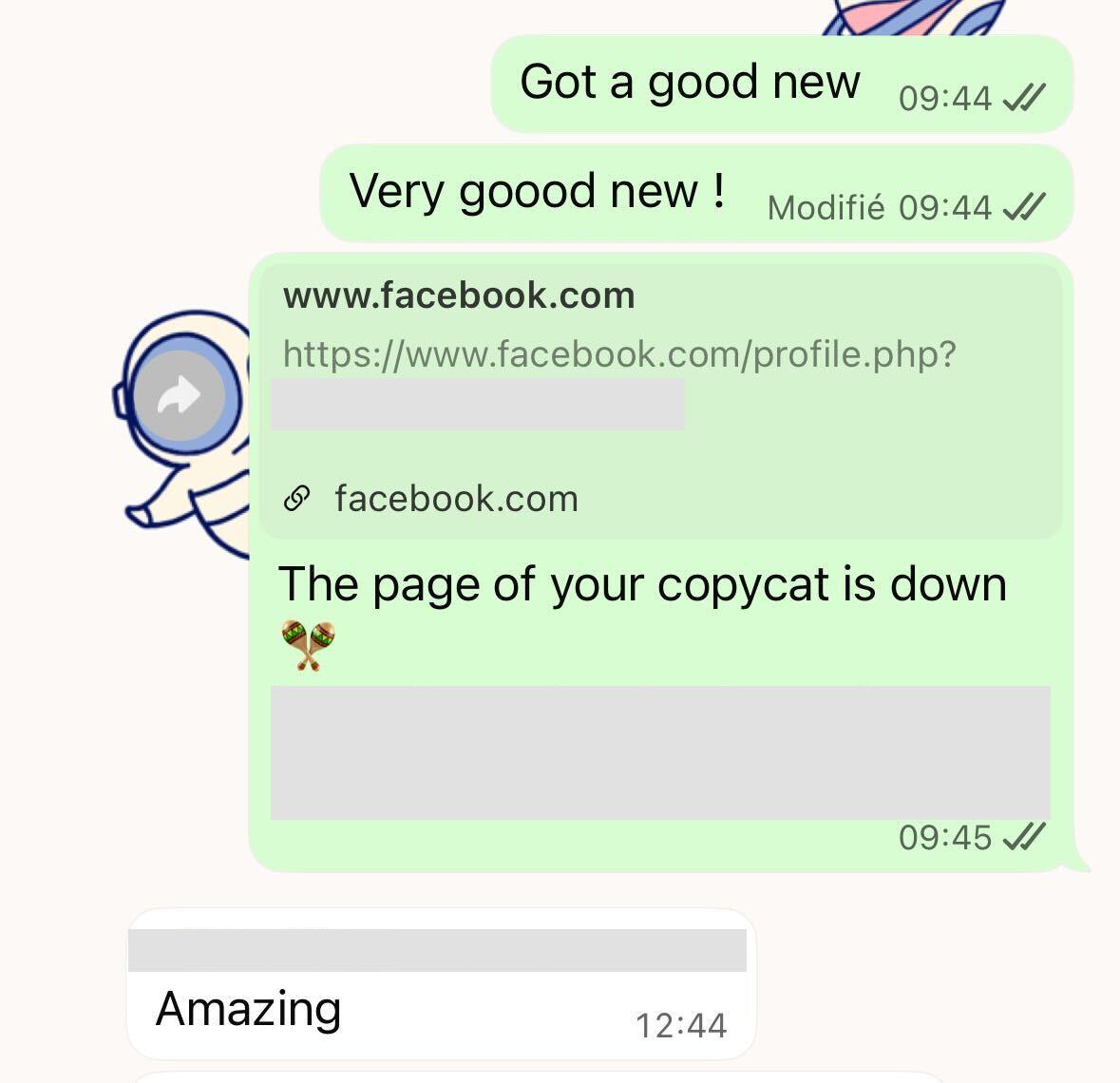
Meta and Instagram ad takedowns are priority number one, because they stop the immediate auction damage. A formal DMCA and IP-infringement filing combined with coordinated mass reporting creates dual pressure, and the ads start getting affected quickly. Shopify store takedowns run in parallel, but they carry a real risk. If the copycat counter-reports, Shopify can restrict both stores during the investigation. That is exactly why strong documentation and a properly constructed IP claim matter. Domain takedowns through the registrar are the slowest, often weeks to months.
For the exact filing mechanics, the Meta and Shopify forms, the order, and the Rights Manager auto-strike tactic, follow the step-by-step guide: how to file a DMCA takedown on Meta & Shopify.
Realistic timelines
| Action | Typical timeline | Depends on |
|---|---|---|
| Ad disruption via mass reporting | Days | Report volume, IP-claim strength |
| Formal Meta/IG DMCA result | Weeks | Documentation quality, appeals |
| Shopify store takedown | Varies | Trademark status, counter-reports |
| Your CPM recovery after removal | Days to 1-2 weeks | How long they ran, your account health |
| Domain takedown (registrar) | Weeks to months | Registrar, trademark, ICANN disputes |
What NOT to do
- Don’t wait. It’s the most common and most expensive mistake. Every day they run compounds the damage.
- Don’t attack them publicly. Angry posts and mocking ads become counter-evidence the copycat can use against you.
- Don’t file weak, incomplete reports. They create a record the copycat references in their counter-report.
- Don’t contact several takedown services at once. Interfering signals slow everything down.
How to become un-copyable
This one is worth its own playbook. See the full guide to protecting your store from DMCA takedowns (owning your content, branding, trademark and Rights Manager auto-strike).
You can’t stop people copying you. But you can make yourself far faster and cheaper to defend. Two moves do most of the work.
Register a trademark (via the USPTO in the US or EUIPO in Europe, typically a few hundred dollars). It turns “looks like mine” into “provably mine under registered law,” which dramatically speeds up how every platform responds and makes counter-reports far less likely to succeed. And keep IP documentation from day one: original creative files with timestamps, designer correspondence, dated records of first publication. Add light monitoring, periodic Meta Ad Library checks and reverse image searches, to catch copying early, when it’s cheapest to stop.
Brand your creatives so they can’t be reused. If your ad clearly shows your logo and your product solving the customer’s problem, a copycat can’t just swap in their own branding. And you keep ironclad proof the content is yours. Generic stock-style ads with no visible product are the opposite. Roughly 95% of that is trivially copyable, leaving you nothing to prove ownership. Branding also protects against the nastier move: a smaller or later competitor filing a DMCA against you to knock you offline. That’s where the trademark matters most. In most countries filing is cheap, and you don’t even need it finalised. The dated proof that you filed first is often enough to defend your content while it processes.
Get the copycat taken down, properly
Filing a takedown that actually sticks, strong enough to survive counter-reports, in the right order, fast, is exactly what our team does. Unlimited Scaling’s brand & asset protection handles the Meta and Instagram DMCA and IP filings, Shopify takedowns with legal teams, and coordinated reporting pressure, on legitimate IP claims we assess before filing. Brands often see their auction performance improve before the takedown has even fully executed.
After the takedown: protect the performance, not just the assets
A copycat fight, or a wrongful DMCA against you, rarely stays contained. Paused ads, refund requests, shipping chaos and confused customers while you scramble all feed the customer-experience signal behind your Facebook feedback score. A dented score means higher CPMs and more ban risk long after the copycat is gone. Once your assets are safe, rebuilding that score is the highest-leverage move for your delivery. It’s the difference between recovering and quietly overpaying for months.
How to remove a copycat Shopify store
To remove a copycat Shopify store, file where the infringement actually lives. That means a DMCA takedown with Shopify (plus the copycat’s host and payment processor) for stolen product photos, copy or code, and a Meta IP report for cloned ads or pages. Send the notices in the right order, platform host first, then the ads, and document everything before you act. A registered trademark makes removal far faster. Without one you’re limited to copyright claims on the exact assets they lifted.
Spy on the copycat before they kill your ads
The best defence against a copycat isn’t a takedown filed after the damage is done. It’s watching them so closely that you catch the copy on day one and act before they can claim your content as theirs. In our experience helping ecom brands scale, the store owner is almost always surprised by how many copycats there actually are. People tell us they have “two or three competitors,” and when we run a proper third-party check we routinely surface fifteen to twenty stores running the same product profitably. If you think you have no competitors, you either can’t see them yet or they’re already on the way.
Monitoring the people copying you gives you two things.
- An early-warning system. The moment a copycat starts running your exact creative, you want to be the first to know, not the last. Acting fast lets you claim ownership and file before they do. When you move that quickly, they often panic. They can’t work out how you already know, and the pressure alone gets many of them to pull the ads.
- A read on your own account health. This is the insight most people miss. If you and a copycat are running near-identical products and creatives but they’re paying dramatically less to reach the same audience, that gap is a signal. In our experience it often means your account is carrying a flag or an elevated cost problem, not that they’re smarter. A sudden, unexplained cost gap is worth investigating the same way you’d investigate a CPM that jumped for no obvious reason.
Tracking tools such as Winning Hunter or TrendTrack let you drop in a competitor’s domain and watch which new ads and angles they push and which ones stick. One caveat from experience: what these tools show you and what is actually happening inside a competitor’s ad account are rarely the same. Treat the tools as a tripwire. When they show a copycat suddenly scaling or lifting your creative, that’s your cue to look harder and, if it’s your content, move.
The copycat you should actually fear: copy, improve, undercut
Not every copycat is a lazy dropshipper slapping an AI voiceover on your video and halving the price. The most dangerous one, in our experience, isn’t another media buyer at all. It’s a manufacturer-adjacent competitor with direct factory access. They copy your offer, improve the product, and then undercut you on price and quality at the same time, because they own the part of the chain you’re buying from at a markup.
That reframes what “protecting your store” really means. A takedown removes a thief. It does nothing against a competitor who can simply make a better version cheaper. Against that threat, your defensible moat is the stuff that can’t be lifted from a product page.
- Brand and trust. The reviews, the recognisable identity, the customer relationship. Cold traffic ultimately buys who it trusts, and trust is the one asset a copycat can’t paste into their store overnight.
- Speed. If your product is copyable (and most dropshipping products are), your lead is measured in weeks, not years. The brands that survive treat every winner as a head start to bank, not an annuity to coast on.
- Owned audience. Email and SMS lists, a warm customer base, so a price war on cold traffic isn’t your only battlefield.
Legal takedowns and un-copyable branding work together. The DMCA process buys you time, and the brand is what you build with that time.
When the copycat weaponises the system against you
Copycats don’t only steal. The aggressive ones try to use the same tools against you. Two attack patterns come up repeatedly in the reports we see, and both are worth understanding before they happen.
The fake DMCA against your winner
A copycat who sees you scaling can file a copyright claim against your ad, asserting your content is theirs, to get your winning creative pulled at the worst possible moment. The defence, in our experience, is preparation rather than reaction. Do a proper photo and video shoot of your product with your own light branding baked in, so ownership is obvious and provable. The party that can demonstrate original, branded, dated content is the one who wins the claim. If you’re only reacting once the notice lands, it’s usually too late, because they’ve already asserted it’s theirs. Being the one holding the branded originals is what lets you flip a fake claim and go on the offensive instead of scrambling to defend. There’s more on defending against wrongful claims in the takedown sections above.
The fake-review page-score attack
Some owners are convinced a competitor is flooding their Facebook page with fake bad reviews to drag their score down. Here’s the honest read from what we’ve seen: it’s much harder to pull off than people assume. A competitor can’t sit there posting hundreds of reviews from their own account. Meta doesn’t let a single account behave that way. It’s not impossible with enough coordinated help, but it’s rare. Most of the time a dropping page rating has a more ordinary cause hiding in the customer-experience signals behind your Facebook feedback score, shipping complaints, refunds, or slow support, rather than sabotage. Before you blame a competitor, it’s worth diagnosing the back end to see what’s actually moving the number, because the fix is very different depending on the cause.
The through-line on both attacks is the same. The brand that has registered and branded its assets in advance, and that watches its own signals and its copycats continuously, is almost never the one caught off guard.
How to remove a copycat, step by step
Removing a copycat comes down to filing the right report with proof that holds, in the right order. First, decide which weapon fits: a DMCA takedown when they copied your creative, video or product photos, a trademark report when they used your brand name or logo. Second, gather evidence that you own the original, real photos or footage beat copied wording every time. Third, file on Meta to stop the ads, and on the host to kill the store behind them.
Across the cases we have handled, the copycats that came down fastest were reported with owned images or video, and the claims that failed were the ones built on copied text or ideas alone. File clean, file with proof, and most copies start getting pulled within days.
FAQ
Someone copied my Shopify store, what should I do first?
Document everything before you act: screenshot the copycat’s ads in the Meta Ad Library, their store pages, the images and descriptions they lifted, and their domain, all with visible URLs and timestamps. Then act in order: Meta/Instagram ad takedowns first (fastest, stops the auction damage), Shopify store takedown in parallel, domain last. Don’t post about it publicly or file weak reports.
Does a copycat actually hurt my Facebook ads?
Yes. A copycat running your stolen creatives bids against you in the same auction, and the bad customer experiences they create can bleed negative signals back onto how Meta evaluates you, pushing your CPM up. Getting them removed often shows up as a CPM drop in your Ads Manager within days.
How do I stop people copying my store in the first place?
You can’t fully stop it, but you can make yourself fast and cheap to defend. Register a trademark (USPTO or EUIPO, typically a few hundred dollars). It turns “looks like mine” into “provably mine under law” and speeds up every platform’s response. Keep timestamped IP documentation from day one, and monitor the Meta Ad Library and reverse image search to catch copying early.
Written by Mouss, founder of Unlimited Scaling, an agency that has helped 1,000+ e-commerce brands recover and protect their Meta ad assets. Based in Bali, he has spent 8+ years inside the mechanics of Meta’s ad ecosystem, feedback scores, HIVA tiers, agency accounts, bans and appeals, and shares field data from real client cases. Follow him on Instagram @mouss_unlimitedscaling.