Facebook & Meta Agency Ad Accounts: What They Are and Why Top Advertisers Use Them (2026)
A Facebook or Meta agency ad account is an ad account that runs under an advertising agency’s Business Manager. It’s sourced through an official Meta reseller partner, not the standard self-serve account you open yourself. Because it inherits the agency’s higher Business Manager trust, it comes with a higher (or no) spending limit, steadier delivery, and far more resilience when Meta runs its ban waves. Here’s the part nobody says out loud: Meta doesn’t treat every ad account the same. Some are built to scale. Most aren’t. And at scale, the infrastructure underneath your ads is the real leverage.
Almost every serious e-commerce advertiser we work with runs on agency accounts, usually alongside their own. It has almost nothing to do with the ads themselves and everything to do with the account sitting under them.
So let’s go through the whole thing. What an agency account actually is. Where the real ones come from. How they differ from a standard account, who they’re for, how the process works, and how to pick one.
What is a Facebook (Meta) agency ad account?
A standard ad account is the one you open yourself inside your own Business Manager. It starts with zero history. Every trust and quality signal, from spend limits to delivery to how hard Meta scrutinises you, has to be earned from scratch. An agency ad account works differently. It lives inside an advertising agency’s Business Manager, provisioned through one of Meta’s official reseller partners. You advertise through an account that already carries the agency’s standing with Meta, instead of building that standing alone.
The most legitimate ones trace back to a specific origin. Accounts like HTTPool, one of the top official Meta reseller agencies, were special accounts handed to regional agencies to help grow Facebook advertising around the world. Because of that status they came with no spending limits, better performance, far lower ban exposure, and special access to Meta reps. That’s what an “agency account” really points to. Not a generic label, but an account riding on genuine partner infrastructure.
The distinction that matters isn’t the label. It’s the Business Manager underneath it. Meta evaluates the BM at the top of the hierarchy, and that evaluation sets a ceiling on everything below it. Start under a high-trust BM and you start above that ceiling.
Why serious advertisers use them
Four reasons come up again and again across the accounts we manage:
- Business Manager trust drives performance. In our experience, the higher the BM’s standing, the better your delivery and the lower your effective CPM at the same bid (more on your Business Manager score and quality). An agency account hands you that trust on day one instead of asking you to earn it over months.
- Higher or no spending limit. Standard accounts throttle you with spend caps that tighten at the exact moment you’re trying to scale. Agency accounts, running under an established BM, usually lift or remove that ceiling. It’s the single most requested reason brands come to us (more on running a Facebook ad account with no spending limit).
- Resilience in ban waves. When Meta runs a wave of bans, we consistently watch personal and self-serve accounts get swept while agency accounts stay untouched. It isn’t a guarantee, but the gap in survival is often night and day (full breakdown: do agency ad accounts survive Meta’s ban waves?).
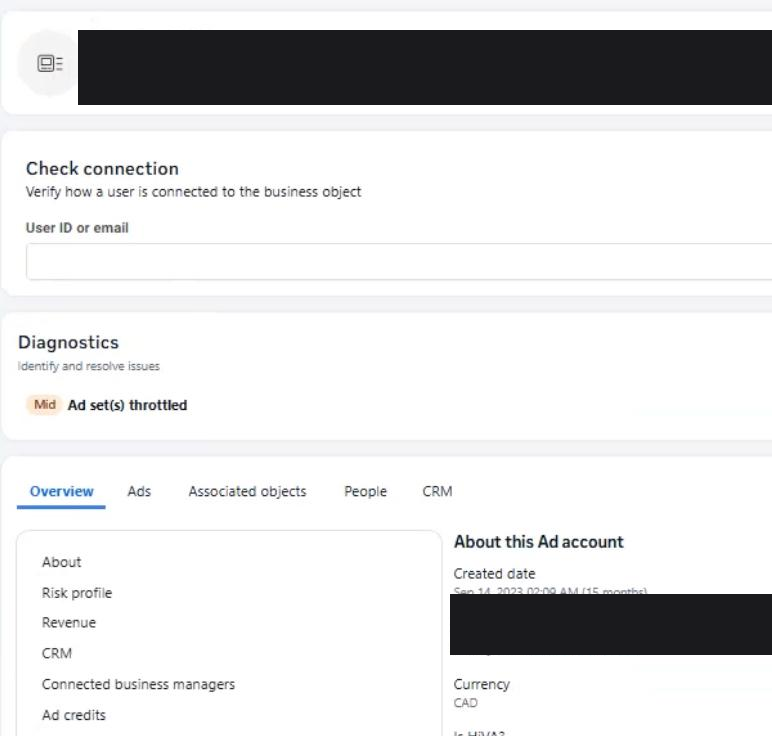
- Faster, steadier scaling. Less time stuck in learning limbo, fewer unexplained delivery stalls, more room before you hit a wall. That’s the practical result of a higher HIVA tier (legitimate agency accounts typically start at GOLD or PLATINUM).
Agency account vs. standard account: the real difference
It’s tempting to think an ad account is an ad account. It isn’t. The creative, the targeting, the budget you control are all identical. What changes is the foundation they run on.
Who it’s actually for: the spend threshold
Agency accounts aren’t for everyone, and they’re not supposed to be. The edge only shows up once real money is on the line. As a rough guide, they’re built for advertisers spending (or planning to spend) roughly €30k+/month, and the infrastructure genuinely earns its keep in the €50k–€5M+/month range. Below that, a clean, well-structured standard account is usually fine. The agency edge matters most once spend caps, ban anxiety and delivery ceilings start costing you real revenue.
There’s a level above this too. What we see separate the true 7-figure operators, beyond agency accounts, is a direct relationship with a Meta rep. That becomes realistic once you’re spending north of $1M/month on a stable basis. At that point the rep relationship can change everything about how you scale. Agency accounts get you the trusted infrastructure. The rep relationship is the ceiling above it.
Where agency accounts come from: official resellers vs. risky “buying”
This is where you have to be careful. Legitimate agency accounts are provisioned through official Meta reseller partners. There are only a handful of them, and HTTPool is one of the top ones. Going through a real partner means the account is sanctioned, supported, and stable, with a proper top-up system behind it instead of a payment method that can vanish mid-scale.
What you should not do is buy random “aged” or “verified” accounts from grey-market sellers. Those are often stolen, fake, or already flagged, and when they go down, they take your campaigns and your data with them. As the ban experts we’ve interviewed put it bluntly: it’s simply better to rent through a legitimate agency than to buy, because renting protects the account and keeps it supported. Get the model right first: buying vs renting a Facebook agency ad account.
How it works
With a legitimate provider the process is deliberately simple, and it starts with a screening, because not every business qualifies:
How to choose the right agency account provider
There’s no single best account for everyone. In our experience, the smart move is to test a few reputable providers and see which one fits your business, because not every business qualifies for the best accounts, and the ideal setup depends on your niche, spend level, and product. Here’s what to weigh:
- Legitimacy. An official Meta reseller relationship (e.g. HTTPool), not a marketplace listing.
- BM standing. The trust and quality of the Business Manager you’ll run under.
- Spend headroom. The limit you’ll actually get, and how it scales.
- Support and cash flow. How top-ups and payment work. Agency billing differs from self-serve (you top up through the provider), and that affects cash flow.
- Fit. Whether your niche and history get accepted at all.
Is an agency account right for you?
If you’re spending meaningfully and hitting spend caps, ban anxiety, or unexplained delivery ceilings, an agency account is usually worth it. Most brands at scale run one, often alongside their own account as a fallback. If you’re just starting and spending small, a clean, well-structured standard account is fine for now. The agency edge matters most once real money is on the line. Most advertisers try to scale harder. The top players scale smarter, and infrastructure is where that starts.
Set up the right account structure, with people who do it daily
Matching the right agency account and provider to your business, then structuring it so it survives scale and ban waves, is exactly what our team does. Unlimited Scaling provides official HTTPool agency accounts and has helped 1,000+ e-commerce brands run on the right Meta assets, recover banned ones, and scale without hitting the usual ceilings. No guarantees, no grey-market shortcuts. Just the right structure, done properly.
For the full breakdown of the types, the four trust tiers, and how to vet a provider, see which agency ad account you should use in 2026.
The types of agency ad accounts, and how to spot a good one
Here’s what most “agency account” offers won’t tell you: they’re not all the same product. Around a year and a half ago Meta wound down its official “trusted partners” program, and a wave of agencies popped up to fill the gap. They source their accounts in very different ways, with very different quality.
Broadly, an agency ad account comes from one of three places:
- Genuine accounts from a top-tier official reseller. Meta works with only a small number of official resellers. A clean pool from one of them is the real edge.
- Old Business Managers being re-rented. BMs that once held many trusted ad accounts, now re-leased. Fine if that trust is still intact, but it may not be.
- Warmed-up standard BMs. Ordinary Business Managers slowly aged until they behave like an agency BM. These carry the least inherent trust.
The four tiers of trust
Agency Business Managers sit on a trust ladder, think tier 1 (highest) down to tier 4. A tier-1 pool has the strongest relationship with Meta and the best benefits (higher spending limits, lower CPMs, more stability). What ultimately drives your results is BM trust: the higher the Business Manager’s trust, the better your performance and the cheaper your ads.
The catch most people miss: trust decays. If a pool’s accounts get misused, or clients run bad or non-compliant ads, the whole BM’s standing drifts down over time. So a BM that was a “big agency” account in the past can be degraded today. And a disciplined provider can also build trust up from a cold account. What matters isn’t the label. It’s how hard the provider is on compliance and how carefully they warm and protect the pool.
How to pick the right one
- Vet the provider, not just the account. Ask how they warm accounts, how strict their compliance is, and how they protect the pool. A careless provider will hand you shaky performance and an eventual restriction, no matter how good the “tier” sounds.
- If your business is clean and strong, ask for white-hat / top-pool accounts. Not every business qualifies for the best pools. A clean track record is what unlocks them.
- Test more than one provider over time and keep the ones that actually perform. Think long-term: will this account still be delivering, and still standing, in six months?
Going deeper: why agency accounts get shut down, and how to get unlimited ad spend without an agency account.
The real advantages, including one nobody tells you about
Most guides stop at “no spending limit.” The bigger advantages of a proper agency ad account are the ones that quietly protect your business:
- Your data lives on the account itself, not just the pixel. This is the one most advertisers get wrong. Contrary to common belief, a lot of your optimization history and learning sticks to the agency ad account, so even if your other assets get blocked, you keep that data and momentum on the agency account. In practice a block somewhere else doesn’t reset your advertising to zero. It’s a genuinely underrated form of insurance.
- It’s portable. The account can be moved to any setup. Change stores, launch a new brand, restructure, and keep the same account with its optimization intact instead of warming a cold one from scratch. For anyone who iterates on offers or stores, that continuity is worth a lot.
- No spending limit and a higher approval rate. You’re not capped at the usual $50-a-day-style ceilings, and ads tend to clear review more smoothly on a trusted account.
- It rarely gets blocked, and when it does, it’s usually recoverable. A strong agency can often unblock or move the account, so you’re not locked out the way you’d be on a self-serve setup.
How to get an agency ad account safely, what to check before you commit
Most searches for an agency account to buy end badly because people shop on one number and skip the questions that actually decide whether the account lasts. Before you commit to any provider, check these, in this order:
- Are unblocks included? The cheapest offers often are not. The moment you get restricted, an account with no unblock support is worth very little, and that is exactly when you need it.
- Do the country, currency and timezone match your market? These are not cosmetic. They affect your reporting and can affect delivery.
- Is the provider stable? Treat it like picking a long-term partner, not a one-off deal. A provider chasing volume too hard can be shut down and take client accounts with it, so prioritise stability over the flashiest rate.
- What is the fee, and what comes with the card? The percentage tracks your risk, and the card and cashback that come with the account change your real cost. Ask about both, not just the headline rate.
- Does your data stay portable? A good account keeps your optimisation history on it, so you are not starting cold if you move.
Get those answers before anything else, and you avoid the setups that look cheap and collapse when it matters. If you would rather not vet providers yourself, here is how to get a vetted agency ad account matched to your risk, volume and market.
The card and cashback angle most people miss
Advertisers compare agency accounts on one number, the fee, and stop there. The accounts actually differ on two more dimensions that quietly change your real cost, and almost nobody asks about them.
- Card or no card. Some agency accounts are pure top-up: you fund a balance and spend it, no card involved. Others come with an actual card attached. Neither is automatically better, but it changes how you fund, how you reconcile, and what perks you can stack on top.
- Cashback or no cashback. This is the one that adds up. Certain business banking cards return real cashback on ad spend. A provider like Slash, for example, is known for meaningful cashback, and at scale a few percent back on every dollar you spend on Meta is not a rounding error, it compounds into a genuine reduction in your cost per result.
So when you weigh two providers, do not only ask what percentage they charge. Ask what the account comes with: is there a card, and does that card earn anything back. Two accounts at the same headline fee can have very different true costs once cashback is in the picture.
One more thing on the fee itself, because it is widely misunderstood: it is not fixed. On most agency accounts the percentage tracks your risk profile. A cleaner, lower-risk advertiser pays a lower rate, a riskier one pays more, because the provider is pricing the odds of a restriction they will have to handle. Knowing which side you fall on tells you whether a quoted rate is fair for your situation. Matching the right account type, card, and cashback structure to your risk and volume is exactly the kind of thing we set up for advertisers day to day.
The honest trade-off: cash flow
The single real downside of an agency account is cash flow. With a normal ad account, you attach a card and the money is charged a few days after you spend. With most agency accounts, you have to top up in advance. The budget has to sit with the agency before you can spend it. For a well-capitalised brand that’s a non-issue. For a lean operation running on tight cash, it’s a real constraint you need to plan around (this is exactly where financing your ad spend matters). It’s not a reason to avoid agency accounts. It’s just something to budget for.
How agency accounts differ: pricing, currency, and unblocks
“Agency account” is not one product, and the fine print is where advertisers get burned. Three differences matter most:
- Pricing model. Most agencies charge a percentage of your ad spend (commonly a few percent up to around ten), while some use an onboarding fee or a monthly retainer instead. None is automatically better. But you need to know which one you’re signing up for, because at scale a spend percentage and a flat retainer are very different numbers.
- Account location, timezone and currency. The account’s country and currency aren’t cosmetic. They affect your reporting and can affect performance. Match the account to your market rather than taking whatever’s cheapest.
- Whether unblocks are included. This is the big one. Cheaper providers often don’t include unblocks, so the moment you get restricted, the main benefit evaporates and you’re stuck. Always ask, before you commit, what happens when an account gets blocked.
How an agency account actually protects you
Beyond cheaper delivery, a good agency account is a protection layer, and this is why serious brands run on them:
- Recovery. If your Business Manager or ad account gets blocked, a strong agency can often recover or move it, so you keep advertising instead of losing everything. On a self-serve account, a permanent block usually means starting over.
- Ban-wave survival. Accounts with a genuine trusted relationship and a real deal with Meta frequently ride out ban waves untouched while fragile self-serve setups get wiped out. In a year of repeated ban waves, that survivability is the whole point.
- Peak-day scaling. On days like Black Friday, everyone advertises aggressively and restriction risk spikes. The extra trust of an agency account, paired with a disciplined, compliance-first approach and moving slowly on the ads, lets you push hard during the window that matters most without tripping the wire.
Should you just become your own agency?
It’s a tempting thought. Cut out the middleman and get the accounts directly. In almost every case, don’t. Becoming an agency means qualifying with Meta, bringing on and managing dozens of clients (you typically need a real book of business to get meaningful access), and carrying their compliance risk on top of your own. Your business is ecommerce, not running an ad agency. The time and energy that would go into building an agency almost always earns more when you invest it back into your own brand. So partner with an established, trusted provider instead of trying to save the fee.
The risk to watch, and how to choose one that lasts
The one thing to stay alert to: agency deals aren’t permanent. Meta resets its partner perks periodically, and agencies that chase volume quotas too hard collapse and take their clients’ accounts down with them. The way to protect yourself is to treat the choice like picking a long-term partner, not a cheap deal. Prioritise stability over the flashiest rate, hold more than one account, and vet the provider properly. If you’re weighing options, our full breakdown of the types and trust tiers of agency accounts walks through exactly what to look for, and if you’d rather not manage a provider at all, there’s the high-tier BM route to consider instead.
FAQ
What is a Facebook agency ad account?
It’s an ad account run under an advertising agency’s Business Manager, provisioned through an official Meta reseller partner (such as HTTPool) rather than opened self-serve. Because it inherits the agency’s established Business Manager trust, it usually comes with a higher or removed spending limit, steadier delivery, and more resilience during Meta’s ban waves.
What is HTTPool and why does it matter?
HTTPool is one of the top official Meta reseller agencies, the kind of partner that was given special accounts to develop Facebook advertising across regions. Those accounts came with no spending limits, better performance, low ban exposure and access to Meta reps, which is what makes a genuine agency account different from a random bought account.
Are Meta agency ad accounts safe and legal?
Yes, when they come through an official Meta reseller partner. That’s a sanctioned, supported arrangement used by most advertisers at scale. What’s risky is buying random ‘aged’ or ‘verified’ accounts from grey-market sellers, which are often stolen, fake, or already flagged. The legitimate path is renting or running through a real agency.
Who are agency ad accounts for, and is there a minimum spend?
They’re built for advertisers spending or planning to spend roughly €30k+/month, and they earn their keep most in the €50k–€5M+/month range. Below that, a clean standard account is usually fine. Above about $1M/month, a direct Meta rep relationship becomes the next edge on top of the agency infrastructure.
Do agency accounts have no spending limit, and do they survive ban waves?
They typically run with a much higher or effectively no spend limit because they sit on a high-trust BM, and in our experience they hold up far better in ban waves. Self-serve accounts get swept while agency accounts under an established BM stay untouched. It’s not an absolute guarantee, but the difference is one of the main reasons brands run them.
Written by Mouss, founder of Unlimited Scaling, an agency that has helped 1,000+ e-commerce brands recover and protect their Meta ad assets. Based in Bali, he has spent 8+ years inside the mechanics of Meta’s ad ecosystem, from feedback scores, HIVA tiers, agency accounts, bans and appeals, and shares field data from real client cases. Follow him on Instagram @mouss_unlimitedscaling.