Facebook Selfie Verification Wave: Why Real Faces Get Banned (2026)
Meta is throwing selfie checks at thousands of profiles at random. And in the wave we’ve tracked since spring 2026, roughly 80% of people who verify get blocked anyway. Real face. Real passport. Blocked. If your profile goes down and you kept no backup, you lose access to everything hanging off it: Business Managers, ad accounts, pages. The move that actually saves you happens before you ever see the prompt.
This isn’t about buying assets or breaking a rule. It’s a platform-wide sweep. Meta cleaning house, flagging anything that smells like risk. A disabled ad account you can often appeal. A banned personal profile sitting under your whole structure is a different animal, and a much harder one. Here’s what’s really going on, and how to protect yourself.
What this selfie verification wave really is
For months now Meta has been pushing forced identity checks, a selfie plus ID, onto huge numbers of personal profiles. Seemingly at random. There’s no clean pattern to who gets hit. It lands on brand-new profiles. It lands on profiles that have run clean for years.
The brutal part isn’t the check. It’s that passing it guarantees nothing. In the wave we’ve been watching, most people who complete verification, real selfie and real government ID, get restricted anyway. The system seems to use the check as a trigger to review the account, not as a simple pass or fail gate.
Why a banned profile is so much worse than a banned ad account
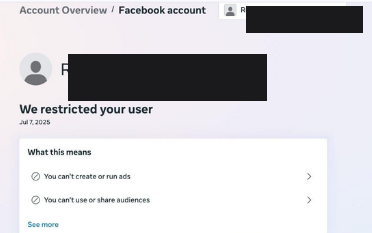
Your personal profile is the keystone of your entire ad structure. Your Business Managers sit under it. Your ad accounts sit under those. Your pages and pixels connect through it. When the profile goes, you don’t lose one asset. You lose the door to all of them at once. People text us in a panic every single day during these waves for exactly this reason. They verified, got restricted, and now can’t reach a single Business Manager they own.
There’s one real exception, and it’s why we keep pointing people to it. An agency ad account lives with the provider, not under your profile. Even if you lose your profile, the agency can re-share that ad account into a fresh structure. It isn’t immunity. But it’s a lifeline that a self-serve account under your own banned profile simply doesn’t have.
The one nuance that improves your odds
If you’ve been served the check and haven’t completed it yet, there’s a detail worth knowing. If it’s genuinely your own account and it’s your first time verifying, doing it from your phone gives you a noticeably better shot at coming back. A first-time verification from a real mobile device reads as more legitimate to the system than repeated attempts or a desktop verification.
That’s the only real edge on the recovery side. It’s not a guarantee. It just tilts the odds. Everything else that actually protects you happens before the prompt.
The real protection: a structure that survives one profile going down
The whole game here is redundancy. A structure hanging off a single profile is one selfie prompt away from zero. A structure with multiple strong, verified profiles and an agency account can lose one profile and keep running.
Two things build that redundancy:
- Multiple strong, verified profiles you actually control. This is where people go wrong. Buying random profiles from random suppliers in the middle of a wave is a losing game. Sellers are sold out, quality is a coin flip, and you end up swapping profiles every couple of days. The durable version looks more like a “family and friends” approach: real, aged, verified profiles tied to people you trust, added to your structure on purpose. Not disposable accounts off a marketplace.
- At least one agency ad account. Because it survives your profile going down, it’s the piece that keeps you advertising while you rebuild. It’s the same resilience that lets agency accounts weather ban waves that flatten self-serve setups.
If this sounds like the setup-the-right-way and multi-page logic, that’s because it is. Same principle, applied to profiles. Never let one asset carry 100% of the business.
What to do, depending on where you’re standing right now
The hard truth on that middle column. If you’re already banned and you had no backup profile, there’s no reliable appeal for a profile caught in one of these sweeps. The realistic path is to rebuild. A fresh, clean structure, and you move whatever survived into it: your agency ad account, and any pages that were held under other profiles. That part is recoverable. Getting the original banned profile back usually isn’t.
Secure your setup before the prompt finds you
The pattern in every one of these waves is the same. The people who are fine are the ones who built redundancy before they got hit. Once you’re staring at the verification screen, your options have already narrowed. Our team secures ad structures: adding strong verified backup profiles and agency ad accounts, and moving your surviving assets into a clean setup if you’ve already been caught. If you want us to protect your structure, or tell you honestly whether a banned asset is recoverable, reach out.
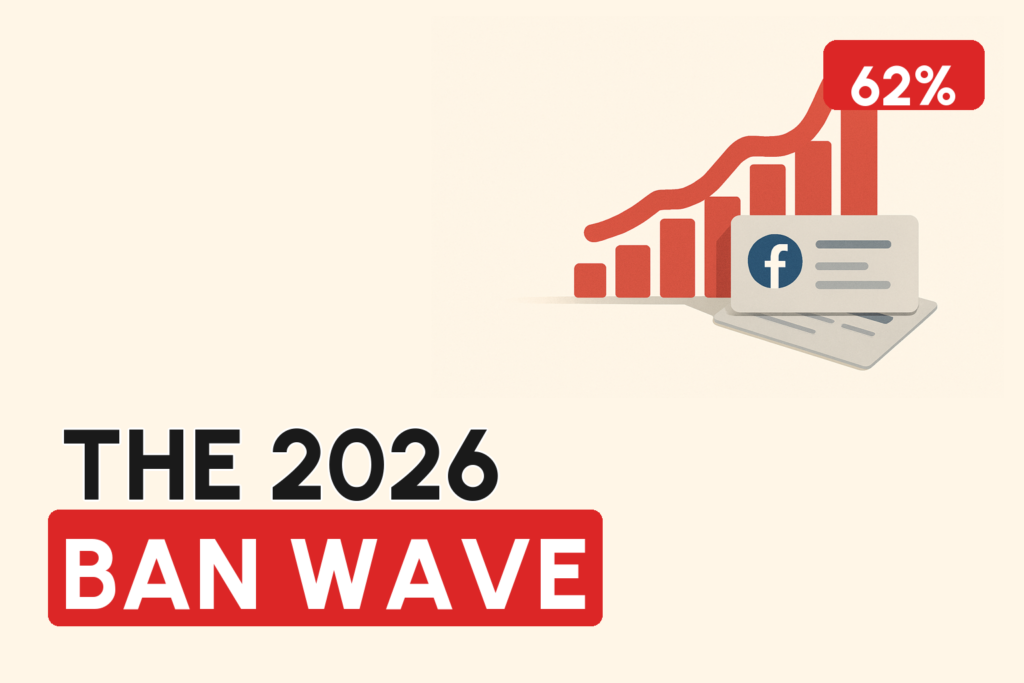
The selfie-verification push is part of the wider 2026 Meta ban wave.
The verification wave rarely travels alone
One thing that gets lost in the panic over the selfie screen. In the waves we’ve tracked through 2026, the forced verification tends to show up alongside two other symptoms hitting the same accounts. It reads less like an isolated identity check and more like Meta running a broad clean-up, flagging anything that looks like risk in one pass.
- Random, uncontrollable spend. In the April 2026 sweep especially, we saw accounts start spending erratically. Burning budget you didn’t set and can’t rein in, right as the verification prompts went out. If your delivery suddenly goes haywire, treat it as a signal the account is already under review. Not a bidding fluke.
- Collateral damage to pages and ad accounts. Because the profile sits above everything, a profile caught by the check can drag the pages and ad accounts beneath it into the same restriction. That’s why people describe losing “everything at once” rather than a single asset.
For scale: across roughly 935 client cases we logged between March and June 2026, the share of accounts getting banned climbed from about 43% to 62% in four months. That’s our own client data, not a Meta-published figure. But it’s the reason this wave feels different from the usual background noise. If your CPMs spiked at the same time, that’s often the same underlying flag surfacing in delivery.
Who the wave actually hits, and who quietly rides it out
The prompt looks random, and to a large degree it is. But in our experience, the people who get wiped out and the people who barely notice fall into two very consistent profiles.
Hit the hardest: a single personal profile carrying the whole business, messy Business Managers with assets tangled together, and old policy violations that were never cleaned up. When the check lands on a setup like that, there’s nothing to fall back to.
Ride it out: diversified setups, clean assets, and real backups. As a rough floor, we push clients to keep at least three strong, verified profiles in their structure rather than “a backup” in the singular. Enough that losing one is a shrug, not a shutdown.
There’s also a quieter lever most people ignore: lowering your odds of being flagged in the first place. Meta runs hidden internal quality signals, the mechanics behind the old feedback score and your high-value-advertiser standing, that in our experience feed the same risk read deciding who gets swept up. None of that is Meta-published, and it’s not a guarantee. But accounts sending consistently positive signals, clean refund and delivery history, few unresolved complaints, are the ones we see pulled into these waves the least, and the ones that recover most easily when they are.
Why a fresh profile alone gets re-flagged in minutes
The section above says the realistic path after a no-backup ban is to rebuild clean. It’s worth being precise about what “clean” actually means, because the single most common mistake we see is someone spinning up a new profile and plugging it straight into the old wreckage. Same computer, same everything. And getting restricted almost the moment they connect it.
In our experience, a rebuild that survives has to break the links Meta uses to tie a new profile back to a burned one. The usual culprits:
- Same device, IP, or browser session. Reusing the same machine and network is one of the fastest ways to re-associate a fresh profile with a banned one. Isolated, separate sessions matter.
- Same Business Manager, pixel, page, or ad account. Re-attaching any surviving-but-linked asset re-links the whole chain. This is exactly why an agency ad account is so useful in a rebuild. It lives with the provider, so moving it into a new structure doesn’t drag your history along with it.
- Same card, domain, and creatives. Reusing the same payment method or hammering the same raw domain re-flags fast. Domain forwarding and a genuinely different card break that trail. Identical creatives that already ran on the dead account can get recognised too.
And don’t sprint on day one. A brand-new profile that spends aggressively right away reads like a burner and gets re-flagged on sight. The setups that hold are warmed up over a few weeks. Real social activity, completed verification, small starting spend that clears cleanly, the way a normal business would grow into it. This is the same discipline behind the wider 2026 ban wave: the goal isn’t just getting an asset back, it’s not looking like a risk the second you switch it on.
What you can control, and what you genuinely cannot
The hardest part of a wave like this is that some of it is simply not yours to fix. Accounts go down without a reason you can trace. Profiles get the prompt with no pattern behind who receives it. And in this particular wave we also saw accounts spending randomly, burning budget in ways the advertiser could not steer.
You cannot control any of that. What you can control is a shorter list than people expect, and it is the entire game:
- Your backups. Whether a hit interrupts you or ends you.
- How your assets are organised. Clean separation versus everything hanging off one profile.
- Your creative process. The volume of rejections you generate over time.
- Your budget posture. Downscaling a campaign that is not performing instead of forcing it through the wave.
It is fine to keep running during a clean-up, including at a lower budget. Going completely dark costs you momentum you will have to rebuild. The goal is to stay in market with less exposure, not to disappear.
Who gets hit hardest, and who rides it out
Across the accounts we handled during this wave, the split was unusually consistent.
The ones wiped out shared three traits: a single profile carrying everything, messy Business Managers, and violations left unfixed over months. None of those is fatal alone. Together they remove every fallback at once.
The ones that rode it out had diversified setups, clean assets and real backups. As a working target, three strong profiles in your structure is the threshold where a single hit stops being an extinction event. Raising your scores and your HiVA standing pulls in the same direction, because trust is what decides who gets swept up in a broad clean-up and who gets skipped.
The surprise: some accounts came back almost instantly
One thing genuinely stood out in this wave, and it runs against the usual experience. We saw cases where restricted accounts were reactivated with very little friction. A conversation with support, and the account was back.
The accounts this happened to were the protected ones. Clean history, proper structure, nothing accumulated against them. This is not something Meta publishes and we would not present it as a rule, but the pattern was clear enough to mention: during a broad automated sweep, a clean account is not just less likely to be hit, it is dramatically easier to get back. That is the compounding return on housekeeping nobody budgets for.
If you are working out what to do next, the five causes behind most bans covers what to fix first, and the recovery playbook covers the order of operations if something is already down.
FAQ
Why did Facebook ask me for a selfie verification?
Since spring 2026 Meta has been forcing selfie-plus-ID checks on large numbers of personal profiles, seemingly at random, as part of a platform-wide sweep to flag anything it reads as risk. It hits new and long-standing profiles alike, and it’s not necessarily a sign you did anything wrong.
I passed the selfie verification with my real face. Why was I still blocked?
In the wave we’ve been tracking, the majority of people who complete verification get restricted anyway, even with a genuine selfie and real ID. The check appears to trigger a deeper account review rather than acting as a simple pass or fail. Passing it is not a guarantee, which is why backups matter more than the verification itself.
Does verifying from my phone actually help?
If it’s genuinely your own account and it’s your first verification, completing it from your phone tends to give better recovery odds than desktop or repeated attempts. A first-time mobile verification reads as more legitimate. It tilts the odds; it doesn’t guarantee anything.
My profile is banned and I had no backup. Can I get it back?
For a profile caught in one of these sweeps with no backup, there’s no appeal that reliably works. The realistic path is to rebuild a fresh, clean structure and move whatever survived, typically your agency ad account and any pages held under other profiles, into it. The original profile usually can’t be recovered.
How do I protect myself before it happens?
Build redundancy before you’re prompted: keep multiple strong, verified profiles you actually control (real, aged accounts tied to people you trust, not disposable ones bought during a wave), and keep at least one agency ad account, which survives your profile going down because it lives with the provider. Protection only works pre-ban.
Written by Mouss, founder of Unlimited Scaling, an agency that has helped 1,000+ e-commerce brands recover and protect their Meta ad assets. Based in Bali, he has spent 8+ years inside the mechanics of Meta’s ad ecosystem, from feedback scores and HIVA tiers to agency accounts, bans and appeals, and shares field data from real client cases. Follow him on Instagram @mouss_unlimitedscaling.